One Taste by Ken Wilber
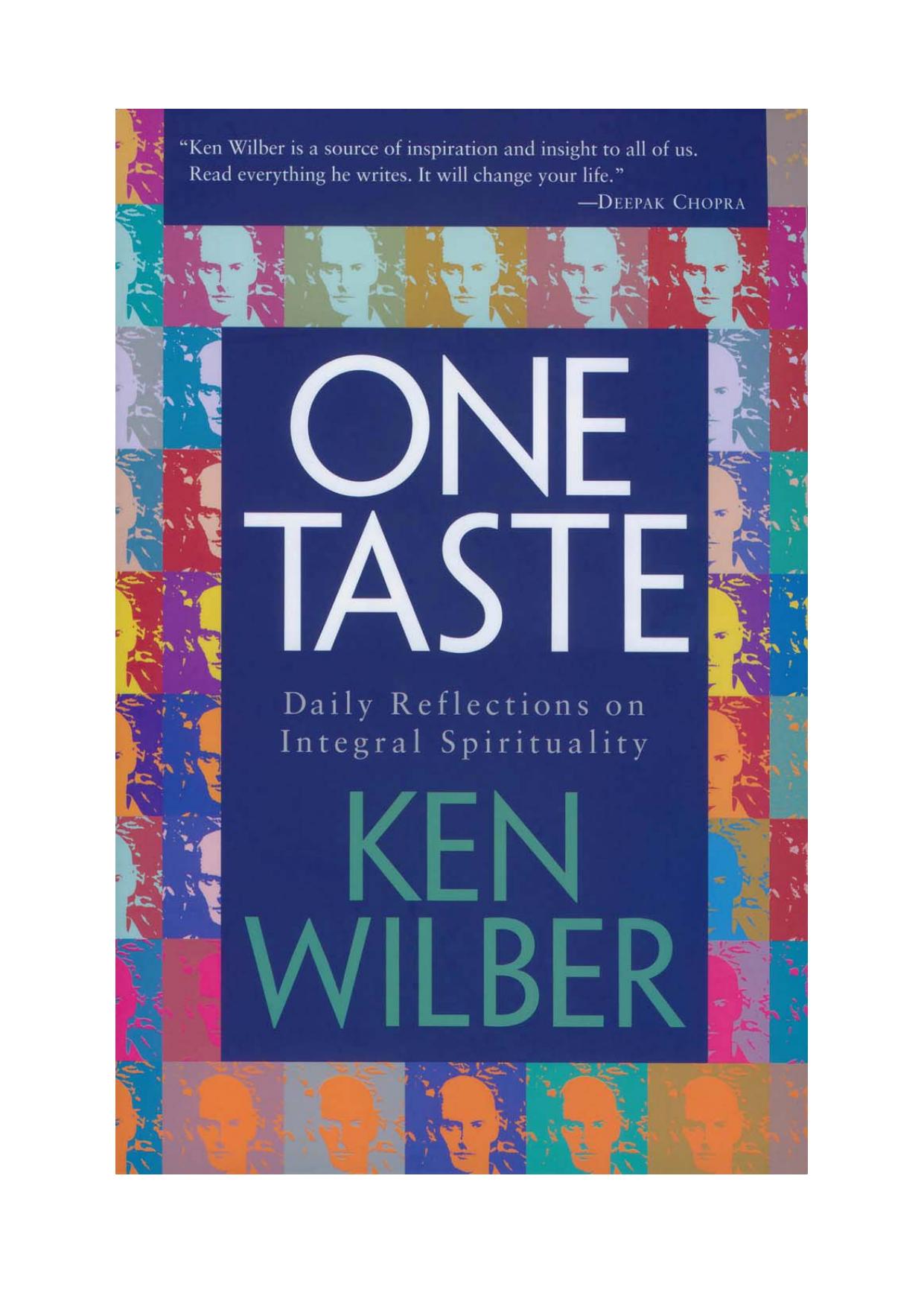
Author:Ken Wilber [Ken Wilber]
Language: eng
Format: epub, pdf
ISBN: 9780834822702
Publisher: Shambhala Publications
Monday, August 18—Boulder
Just got off the phone with Professor Sara Bates, who is using Brief History and Eye of Spirit as texts for her classes on art and native cultures. She teaches at Florida State but is now visiting lecturer at San Francisco University, from which she phoned me. Sara is Cherokee Indian; she and two of her friends—one a Hopi, one a Mojave—have formed a discussion group concerned with issues of cultural studies, religion, art, and native societies. They are using my work, she says, because of its cross-cultural and integral nature.
“What do you think of this new interest in Native American spirituality?” she asked.
“I think that middle-class white people do some very strange things with Native beliefs.”
“I’ll say. This whole romanticizing of Native belief is sad. Because that romantic view just doesn’t exist; certainly not now, and maybe not ever. But a lot of Indians now go along with it.”
“Yes, it’s strange. Many Natives are buying the white man’s version of the Natives’ spirituality. It’s weird.”
“I’ve had this experience,” Sara said, “of communing directly and immediately with an inner Light. This is a common type of spiritual experience in my tradition. One of my colleagues said, ‘Do you think you have to be a Cherokee in order to have this experience?’ He thought, of course, that I would say ‘Yes,’ but I said, ‘No, of course not!’ “
Sara is referring to the fact that extreme postmodernism has now slipped into a rather sad essentialism: you have to be a woman to know anything about women; you have to be an Indian to say anything about Indians; you have to be gay before you can explain anything about homosexuality. In other words, there is a regression from worldcentric to ethnocentric—identity politics alone rule, and extreme pluralism means none of us have anything in common anymore.
In this regressive atmosphere, as David Berreby puts it, writing in The Sciences, “Americans have a standard playbook for creating a political-cultural identity. You start with the conviction that being a member of your group is a distinct experience, separating you from people who are not in it (even close friends and relatives) and uniting you with other members of the group (even if you have never met them). Second, you assume that your own personal struggles and humiliations and triumphs in wrestling with your trait are a version of the struggles of the group in society. The personal is political. Third, you maintain that your group has interests that are being neglected or acted against, and so it must take action—changing how the group is seen by those outside it, for instance.”
It’s not that such action is bad. It’s just that, taken in and by itself, it is alienating and fragmenting, a type of pathological pluralism that astonishingly believes that acceptance of my group can be accomplished by aggressively blaming and condemning exactly the group from which I seek the acceptance.
True pluralism, on the other hand, is always universal pluralism (or integral-aperspectival): you start
Download
This site does not store any files on its server. We only index and link to content provided by other sites. Please contact the content providers to delete copyright contents if any and email us, we'll remove relevant links or contents immediately.
| Anthropology | Archaeology |
| Philosophy | Politics & Government |
| Social Sciences | Sociology |
| Women's Studies |
The remains of the day by Kazuo Ishiguro(9000)
Tools of Titans by Timothy Ferriss(8398)
Giovanni's Room by James Baldwin(7347)
The Black Swan by Nassim Nicholas Taleb(7132)
Inner Engineering: A Yogi's Guide to Joy by Sadhguru(6797)
The Way of Zen by Alan W. Watts(6615)
The Power of Now: A Guide to Spiritual Enlightenment by Eckhart Tolle(5785)
Asking the Right Questions: A Guide to Critical Thinking by M. Neil Browne & Stuart M. Keeley(5776)
The Six Wives Of Henry VIII (WOMEN IN HISTORY) by Fraser Antonia(5516)
Astrophysics for People in a Hurry by Neil DeGrasse Tyson(5191)
Housekeeping by Marilynne Robinson(4449)
12 Rules for Life by Jordan B. Peterson(4307)
Ikigai by Héctor García & Francesc Miralles(4275)
Double Down (Diary of a Wimpy Kid Book 11) by Jeff Kinney(4273)
The Ethical Slut by Janet W. Hardy(4258)
Skin in the Game by Nassim Nicholas Taleb(4250)
The Art of Happiness by The Dalai Lama(4131)
Skin in the Game: Hidden Asymmetries in Daily Life by Nassim Nicholas Taleb(4007)
Walking by Henry David Thoreau(3963)
